
Some time ago, I was asked by a reporter to comment on why some people never enter into a mature, thoroughly committed relationship.
It’s a good question and there are several reasons that come to mind (I’ll discuss these in just a minute). But it’s important first of all to realize that this question arises frequently. If it is a concern of yours, you are in good company.
Over the past few decades there has been a profound shift away from entering into committed relationships. Significantly fewer people are getting married (the ultimate sign of a committed relationship). More people are simply living together, and the age at which folks are getting married is much older - a sign of commitment reluctance.
Add to this that only one in five young men and women see marriage as a central part of living a fulfilling life, and you begin to see that long-term commitment has, for many, become an unnecessary burden.
Rather than being a hallmark of maturity, commitment is seen as an option with a high cost and having little upside.
That gives you a view of the trend lines on commitment, a view from “30,000 feet.” But, of course, what you are more interested in are the specifics of what is holding your love interest back from moving forward. Let’s look at the four most common reasons I’ve seen in my practice.
ONE: Peter Pan Is Alive and Well

This is more common in men than women. The person simply does not wish to grow up. Being an adult requires that you place your needs (at least much of the time) second to those of others. Particularly those with whom you have a commitment.
Moreover, a committed relationship entails obligations, which means one must be accountable to someone else.
If you are accountable to another person it means you lose some of your freedom. For some individuals, this is terrifying. Others are so self-absorbed they cannot imagine being restrained in this way.
Either way, commitment is a restraint they wish to avoid at all costs.
TWO: Ghosts From the Past

This is another common theme seen in both men and women. Those who grew up in homes where the parents had a horrible relationship are more likely to be afraid of commitment than those raised by parents who had a reasonably happy relationship. This is particularly true if there were no alternative role models (e.g., happily married grandparents, or close friends whose parents were happily married).
For these individuals commitment is akin to ruining their current relationship and risking that it becomes the sort of hellish nightmare they observed in their childhood home. Why take that risk they reason. Leave good enough alone and enjoy what you’ve already built. Don’t tinker with success is their underlying logic.
THREE: Greener Pastures Await

Although seen in both men and women, this is somewhat more common in men.
To boil this down to its essence, the underlying fear is that there may be someone else out in the world who would more fully satisfy your lover’s desires and longings than you.
As a result, committing to a relationship with you means foreclosing the possibility of pursuing that option. (Please realize, this is a huge red flag about the wisdom of your continuing in this relationship).
People who perpetually struggle with the Greener Pastures fallacy have failed to accept that no one will be a perfect match. Anyone with whom they develop a relationship will have strengths and weaknesses.
The Greener Pasture aficionado fails to see that it is not a matter of finding a soul mate who is without flaws. It is all about finding a soul mate with the qualities you cannot live without, and the flaws that you can tolerate (and keep in mind, your soul mate will need to live with your flaws as well, so let’s not put on airs).
FOUR: No Dice, Home Slice
These individuals are simply terrified of rejection and failure. They have no problem being in a relationship as long as it does not involve meaningful commitment. By ‘meaninful’ I am referring to a commitment that is explicit. One that includes clear expectations about each person’s responsibilities to the other, and an agreement about what is desired for the future.
This level of clarity makes these commitment phobes feel as though the walls are closing in from all sides. It highlights that the “we” aspect of a relationship is equally, if not more, important than the “me” of the relationship. This gives rise to more intense fears of rejection and failure. A positive ending is rare.
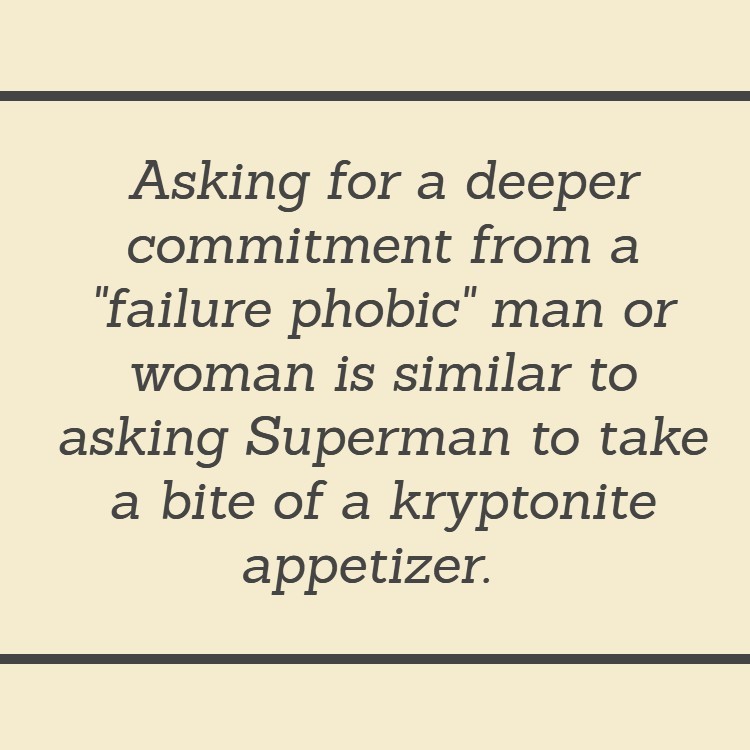
Men and women who are terrified of rejection/failure in relationships believe that were they to make a commitment, and it did not work out, they would be crushed. Devastated beyond repair. Their solution? Play it safe, don’t risk too much, don’t take that big step into commitment.
Very sad. At the end of life, no one looks back and says, “I’m so glad I played it safe. My life has been so rich and full because I always played it safe and never risked my heart.”
Conclusion
So those are the four main obstacles I’ve observed that get in the way of men and women moving forward in relationships to form a mature commitment.
I’ve also seen people change. Men and women are capable of shifting their perspective, of becoming more mature, and discarding those patterns and tendencies that held them back from commitment in the past.
No one is destined to remain stymied by whatever unhealthy approach to life they currently rely upon. It’s about having the courage to try something new.
If you see yourself in one of the patterns described above, then the thing to do is make a conscious decision to change. It’s easier than you think.
And if you identify your romantic partner in one of the patterns described above, don’t avoid having the sort of challenging conversation that will bring this issue into the open.
You cannot force someone to change and become open to commitment. You can, however, become clear about whether the person you love wishes to maintain the status quo or step forward into a more mature way of relating to you.
If you want to build a richer, more committed relationship, and your love interest does not, then you are better off taking matters into your own hands and moving forward on your own.
Each of us is in control of the decisions we make. Deciding to stay with someone who is unwilling to commit to you in the way that you desire is unhealthy. I encourage you to have an honest discussion of what you want out of the relationship. If your love interest tells you that it's not something that he or she is willing to provide, then it’s time to move on.
Simply hoping they will change is not a strategy for building a fulfilling life. Instead, be prepared to make hard and sometimes painful decisions in order to move forward along a path that more closely satisfies your deepest desires. Your ‘future you’ will look back with gratitude on your having made the hard right choice.


